- By: Mughal Barristers
- procedure of divorce in pakistan
- Mar 13
- Comment (1)

Procedure of Divorce in Pakistan – How to Get Divorce in Pakistan
The procedure of divorce in Pakistan is governed by statutory law and Islamic principles. Therefore, understanding the correct legal steps is essential. Otherwise, parties may face delays, invalid notices, or future legal disputes. Consequently, this guide explains how to get divorce in Pakistan in a clear, structured, and legally accurate manner.
Whether you live in Pakistan or abroad, following the lawful divorce procedure ensures your rights remain protected.
Legal Framework Governing Divorce in Pakistan
Divorce in Pakistan is regulated through statutory law. Specifically, the following laws apply:
Muslim Family Laws Ordinance, 1961
Family Courts Act, 1964
Principles of Islamic law
Therefore, these laws apply uniformly across Pakistan. Moreover, they also govern divorce proceedings in Islamabad, Lahore, Karachi, and other cities.
Types of Divorce in Pakistan
Divorce by Husband (Talaq)
A husband may pronounce divorce under Islamic law. However, such pronouncement alone does not complete the legal process. Instead, Pakistani law imposes additional statutory requirements.
Accordingly, the husband must:
Issue a written notice of divorce
Submit the notice to the relevant Union Council
Provide a copy of the notice to the wife
Otherwise, the divorce may remain legally ineffective. As a result, future marital disputes may arise.
Divorce by Wife (Khula)
Alternatively, a wife may seek divorce through khula by filing a suit before the Family Court. In this process, the court evaluates whether the marriage has irretrievably broken down.
Moreover, the court may require the wife to return dower, depending on the facts. Once the decree is passed, the court forwards the order to the Union Council. Consequently, the statutory divorce procedure is completed.
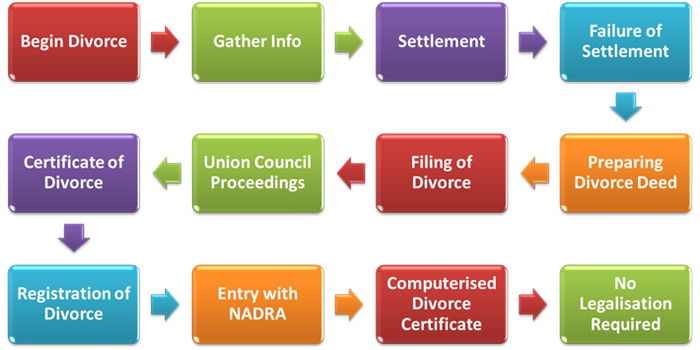
Step-by-Step Procedure of Divorce in Pakistan
Step 1: Issuance of Divorce Notice
First, the divorce process begins with a written notice. This notice must be submitted to the Union Council where the marriage was registered. Without this step, the divorce process cannot legally proceed.
Step 2: Notice to the Other Party
Next, the Union Council formally notifies the other spouse. Meanwhile, the Council records the initiation of divorce proceedings. Therefore, both parties become officially aware of the legal process.
Step 3: Mandatory Reconciliation Period
Afterward, a mandatory 90-day reconciliation period begins. During this period, the Union Council forms a reconciliation council. Its purpose is to attempt settlement between the parties.
However, if reconciliation fails, the law allows the divorce to proceed automatically.
Step 4: Effectiveness of Divorce
Finally, once the 90-day period expires, the divorce becomes legally effective. Subsequently, the Union Council issues a confirmation certificate. As a result, the marital relationship stands legally dissolved.
Divorce Procedure in Pakistan for Overseas Pakistanis
Importantly, overseas Pakistanis may also initiate divorce proceedings. For example, they can proceed through:
Pakistani embassies or consulates
Special power of attorney
Authorized representatives in Pakistan
Therefore, appointing a divorce lawyer in Pakistan becomes crucial. Otherwise, procedural errors may delay the process.
Common Mistakes in Divorce Cases
Unfortunately, many divorces face complications. For instance, common mistakes include:
Relying on oral divorce only
Ignoring Union Council requirements
Filing cases in the wrong jurisdiction
Submitting incomplete documentation
Consequently, such mistakes can invalidate the divorce or trigger future litigation.
Why You Need a Divorce Lawyer in Pakistan
Given the technical nature of family law, professional assistance is strongly recommended. A skilled divorce lawyer in Pakistan can:
Draft legally valid divorce notices
File khula petitions correctly
Represent clients before Family Courts
Complete Union Council formalities
Therefore, legal representation ensures compliance and protects your interests.
Frequently Asked Questions
How long does divorce take in Pakistan?
Generally, divorce takes approximately 90 days after notice submission. However, court-based khula cases may take longer.
Is court mandatory for divorce?
Court proceedings are mandatory for khula. In contrast, talaq does not require court intervention. Nevertheless, statutory notice requirements must still be fulfilled.
Is oral divorce valid in Pakistan?
No. Oral divorce alone has no legal effect. Therefore, written notice and Union Council involvement remain mandatory.
Conclusion
Ultimately, the procedure of divorce in Pakistan follows a structured legal framework. Whether divorce occurs through talaq or khula, strict compliance with statutory steps is essential.
Therefore, consulting a qualified and family law services in islamabad or Pakistan helps avoid errors, delays, and future disputes.
Comment (1)
Divorce and Khula Pakistan – Legal Process & Rights
says January 13, 2026 at 6:03 pm[…] Divorce Procedure in Pakistan […]
Comments are closed.